
Creative Field Trip Workbook (PU)
new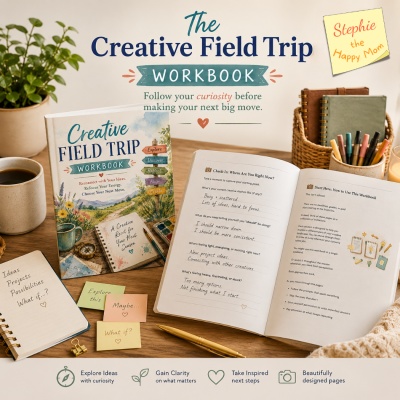
The Creative Field Trip Workbook
Get unstuck when too many possibilities are competing for attention.

Instant PDF download
Too many ideas. Not enough clarity.
You probably don't have a shortage of ideas. You have a shortage of decisions. Every project feels potentially important, every direction feels like it could be right, and the result is a lot of motion but not much forward progress.
A structured way to sort through what's competing for your attention.
The Creative Field Trip Workbook is a guided PDF that walks you through a clear process: inventory what you're currently carrying, identify what's creating energy versus friction, spot patterns in how you work, and choose one thing to focus on next.
It is not a planner. It is not a productivity system. It is not a goal-setting workbook.
You work through it when you feel stuck, scattered, or unsure what to prioritize. The questions help you see what's already there more clearly, so the next decision becomes easier to make.
"The goal isn't to have a better plan. It's to have a clearer picture of what actually deserves your attention next."
Five sections. Work through them in order or jump to what you need.
Each section builds on a different aspect of your creative situation. Use the whole workbook for a full reset, or open to the section that fits where you are right now.

40 pages of prompts, exercises, and planning space.
The workbook covers the full creative sorting process — from where you are right now to what you'll actually do next.

Four things that make this different from other workbooks.
Sorting before deciding
Most tools jump straight to action planning. This one helps you see the full landscape first, so the decisions you make are based on what's actually there — not just what's loudest in your head.
Designed to be reused
Creative situations change. You can work through it whenever you feel stuck again — at the start of a new season, after finishing a project, or anytime priorities shift.
Short prompts, not long essays
Each question is specific and answerable. You are not asked to write a business plan or define your vision. You are asked to look at what's in front of you and name it clearly.
Flexible structure
Work through it in order for a full reset, or jump to whichever section fits where you are. Print it, use it digitally, or do both. No wrong way to use it.
Good fit if any of these sound familiar.
You collect more ideas than you act on
The workbook helps you sort what's worth pursuing right now versus what can wait.
You're building something creative or digital
Products, content, offers — you have options but need help choosing what deserves the next push.
You work on multiple things at once
The inventory section is especially useful when you have several projects running simultaneously.
You start things more easily than you finish them
The pattern section helps identify what keeps interrupting follow-through.
Your work time is limited and fragmented
This helps you decide in advance what gets your best available hours — not just whatever feels urgent.
You feel stuck on a recurring basis
The workbook can be reopened each time the same feeling returns. It is built for repeat use.
Personal use only.
This workbook is licensed for your personal use. Please review what's included before purchasing.
- Print the workbook for your own use
- Complete it digitally or by hand
- Revisit and reuse it as often as you wish
- Apply insights to your business, projects, and goals
- Resell this workbook
- Share or distribute copies
- Claim authorship
- Create derivative products from it
- Use it as PLR, MRR, or commercial content
The workbook helps you connect the dots.
Daily observation helps you collect them.
The Creative Field Trip Workbook gives you a clear picture of where things stand right now. But what you notice during and after using it only stays useful if you have somewhere to record it.
🗒️ Pair it with an Evidence Log
Many people finish the workbook with useful observations — then lose track of them a few weeks later. A daily evidence-collection practice gives those observations somewhere to land, and over time it becomes a record of what's working, what's repeating, and what's shifting.
Used together, they give you both the big-picture view and the day-to-day record that makes the big picture make sense.